
📌 Liberty Mutual Tables – Manual Handling and Ergonomics Risk Analysis
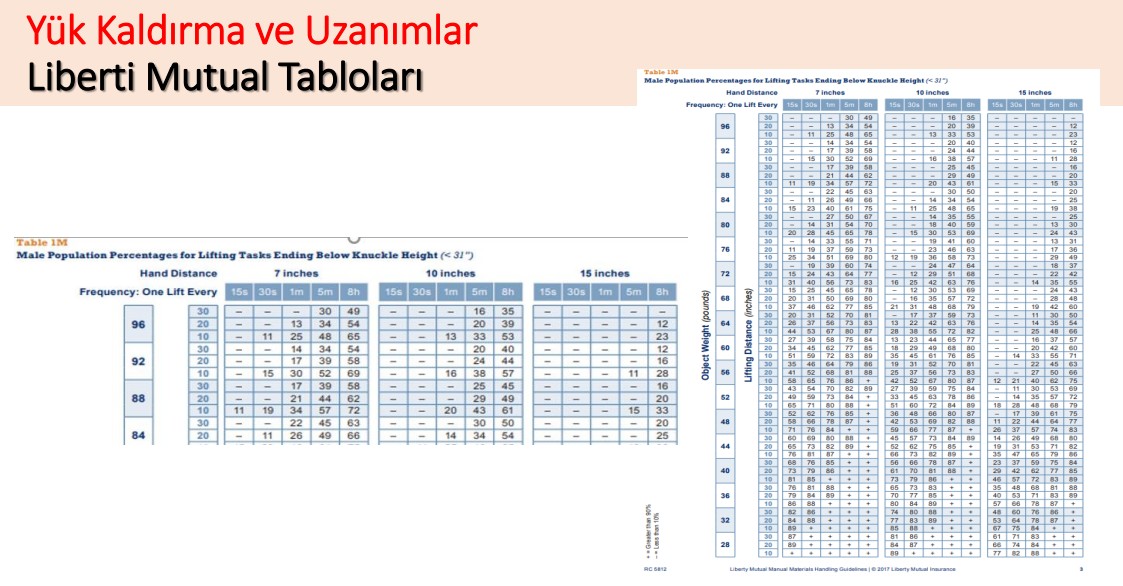
Liberty Mutual Tables (also known as Snook Tables) are a reliable and evidence-based tool developed to scientifically determine the ergonomic risk level of lifting, lowering, pushing, pulling, and carrying tasks in the workplace. Based on research by Liberty Mutual Signal Hallen Insurance Company in the USA, these tables are widely used to measure the load on the musculoskeletal system of workers and to ensure safe job design.
These tables offer an interactive calculation tool that predicts, in percentages, how safely the adult workforce can complete specific tasks. Users select the task type (lifting, lowering, pushing, pulling, carrying) and enter the relevant parameters: load weight, distance, frequency, hand height, and grip type. The tables then show, in percentages, approximately how many men and women can safely complete that task.
This approach is a critical tool, especially for companies that want to make their job design safe for at least 75% of the female population.
🧭 Advantages of Liberty Mutual Tables
1. Feminine Design Goal
Creates job design based on the safe capacity of the female population.
With this design criterion, male employees can generally carry up to 90% more weight.
Strategies focused on equality and ergonomic safety in the workplace can be developed.
2. Precise Scoring System
Key inputs: Load weight, frequency, vertical/horizontal position of the load, grip type
The tables combine this data with rows and columns to give a percentage score per task.
3. Comprehensive Task Range
Lifting
Lowering
Pushing
Pulling
Carrying
Each task can be analyzed separately, thus creating a customized risk profile for each employee.
📚 Scientific Basis and Validity
40-year data set: Dr. The work, beginning with Stover Snook and Vincent Ciriello, was updated in 2021 by Potvin and his team.
Each table is formulated with over 600 observations of Average Maximum Acceptable Load (MAL).
The tables are designed to explain 90% of the total variance.
European OSH and OSHA compliant: These tables are accepted as an ergonomic risk assessment tool within the framework of European OSHA and international occupational safety standards.
🛠 How to Use?
Task Description and Measurement
Field measurements such as load weight (kg/lb), hand height (cm/in), frequency (work/minute), and product distance are recorded.
Hand Coupling Assessment
Box, handle, or surface grip status: Good / Medium / Poor
Medium/Poor classes reduce the score by approximately 16%.
Table Query
Inputs are read at the intersection of table rows and columns to obtain a percentage value.
Safety Target Comparison
If the 75% female threshold is met, the task is safe.
If not met: measures such as load reduction, frequency reduction, equipment use, or position rotation are evaluated.
Reporting and Action Plan
Risk analyses with scorecards are presented to managers.
Position-based action plans are created.
✅ Who Should Use It?
Occupational Safety and Health Consulting Firms and Occupational Safety Specialists
Ergonomists
Logistics and Plant Engineers
Field Managers and Workplace Designers
Advantages:
Single task analysis can be completed within 10-15 minutes.
Provides a design focused on employee satisfaction and safety.
Cost-effective and field-compatible, usable with basic training.
Fully compliant with legal and international standards.
🚀 Conclusion
Liberty Mutual Tables allow you to measure musculoskeletal risks in manual handling tasks as percentages and provide a scientifically based metric that increases employee safety. This methodology; It can be successfully integrated into risk assessment, ergonomics reporting, and employee layout planning processes.