
📌 NIOSH Revised Lifting Equation – Manual Handling Risk Analysis
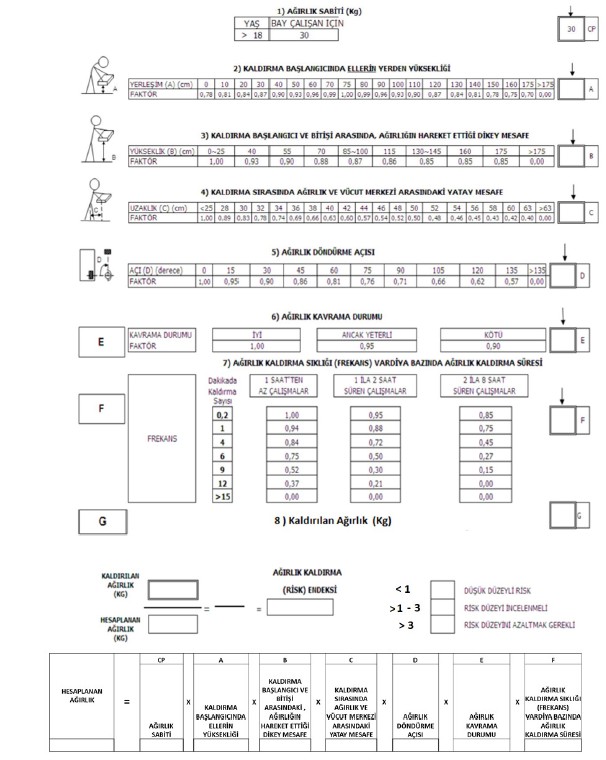
The NIOSH Revised Lifting Equation (NIOSH RWL & LI) is a fundamental ergonomics tool that provides a scientific and mathematical basis for manual lifting tasks. It was developed to predict musculoskeletal risks in the workplace and reduce workplace accidents. It is central to Tokgöz Ergonomics' comprehensive Lifting and Handling Analysis methodology and is a critical tool for creating a safe working environment.
🛠 NIOSH Revised Lifting Equation: Technical Structure
RWL – Calculated Weight Limit:
Represents the maximum weight that can be safely lifted under specific conditions.
LI – Lifting Index:
Obtained by dividing the actual load by the RWL value.
LI ≥ 1 → High risk
LI ≤ 1 → Ergonomically safe
Calculation Factors:
The parameters used in RWL calculation are:
LC (Load Constant) – load constant, adjusted according to the employee's age and gender
HM / VM / DM – horizontal, vertical and carrying distances
AM – Asymmetric posture effect
FM – Task frequency
CM – Grip quality
These parameters enable risk scoring by scientifically evaluating the physical load of lifting tasks.
🔗 NIOSH in the Context of Lifting and Carrying Analyses
The NIOSH equation works integrated with other methods in Tokgöz Ergonomics' holistic risk management approach:
Population-Oriented Methods:
Snook-Liberty Mutual tables are used to analyze workload and frequency according to the employee population.
It provides mathematical threshold values, especially for the safety of female employees.
Quick Screening and Simple Tools:
MAC Tool assesses exposure during manual handling tasks.
Form-based tools like the WISHA Lifting Calculator provide quick and practical analyses.
KIM (Key Indicator Methods):
KIM-LHC analyzes situations involving lifting, holding, and carrying loads of 3 kg and above.
Key indicators such as force, posture, and frequency are scored, enabling quick screening.
Pushing & Pulling Tasks:
RAPP Tool and KIM-PP methods analyze risks in pushing/pulling scenarios using a trolley or wheeled cage.
🎯 Training and Strategic Gains
NIOSH Revised Lifting Equation training provides participants with field application and risk management competencies:
Compliance with Legal Regulations:
Fully compliant with ISO 11228-1/2/3 and the Occupational Health and Safety Law No. 6331.
Practical Competence:
Participants directly apply the NIOSH methodology through field measurements, calculation tools, and case studies.
Sustainable Improvement Plans:
Data collected are transformed into concrete action plans encompassing ergonomic engineering solutions, administrative controls, and cost analyses.
Preventive Approach:
Musculoskeletal disorders (MSDs) are detected and prevented before they occur, increasing work efficiency.
✅ Application Areas
Production and Assembly Lines: Heavy lifting and handling tasks
Warehouse and Logistics Operations: Pallet lifting, stacking, and handling
Office and Light Industry: Simple lifting and handling tasks
💡 Advantages
Mathematical and scientifically based load safety analysis
Objective risk scoring with RWL and LI
Regulatory compliant and compliant with ISO standards
Integration with complementary tools such as MAC, KIM, and RAPP
⚠ Limitations
Only covers manual lifting tasks
Does not assess psychosocial and mental stress → Must be supported by ROSA or Job Strain Index
Expert commentary is needed for real-world field conditions (ground, obstacles)
🔹 Conclusion
The NIOSH Revised Lifting Equation is a scientific decision support tool that enhances worker safety and work efficiency in line with Tokgöz Ergonomics' philosophy of "the best posture is the next posture."
This method makes manual handling processes compliant with both regulations and human physiology, makes risks visible with numerical data, and creates sustainable ergonomics strategies in businesses.