
📌 REBA (Rapid Entire Body Assessment) – Whole Body Posture Analysis
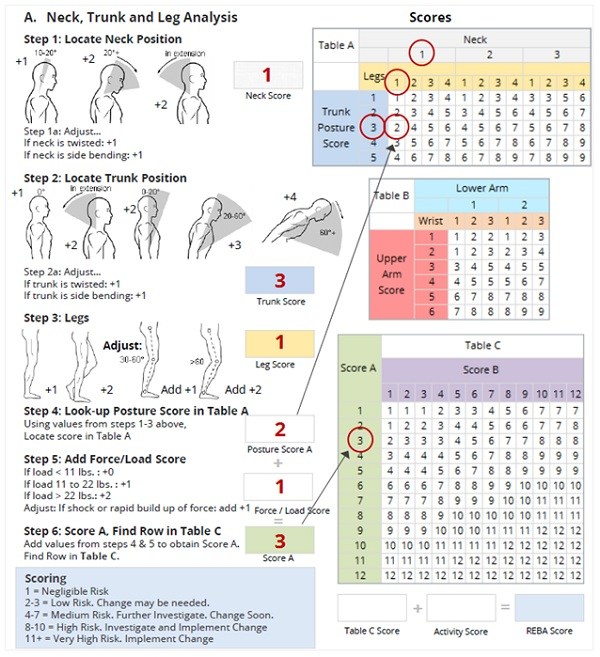
REBA (Rapid Entire Body Assessment) is a critical ergonomics tool that evaluates musculoskeletal (MS) risks in the workplace from a holistic perspective. It was specifically developed to quickly and reliably analyze the physical strain on workers, particularly in field operations and production lines. REBA is considered one of the most effective tools in the context of whole body and posture analysis and is an indispensable part of Tokgöz Ergonomics' comprehensive risk assessment methodology.
🛠 Technical Scope and Application Steps of the REBA Method
Analysis Areas:
REBA evaluates all major body regions individually:
Feet and legs – posture and load balance analysis
Trunk and lower back – strain detection during action
Neck and head – forward/backward bending and rotation movements
Arms and wrists – lifting, extending, and repetitive movement loads
Risk Classification:
Each region is scored, and a total risk score is calculated.
Results are color-coded from “low risk” to “high risk.”
Field Efficiency:
REBA is an ideal tool for rapid field analyses. Experts can perform a comprehensive posture assessment in a short time and identify areas requiring immediate improvement.🔗 Integration of REBA with Other Methods
REBA can be used in conjunction with other tools within Tokgöz Ergonomics' holistic risk management approach:
OWAS:
Analyzes whole-body posture like REBA, but is also easily applicable by field personnel.
KIM Methods:
KIM-ABP: Analyzes mandatory body postures
KIM-BF: Evaluates forces applied to the body
KIM-BM: Measures strains related to body movement
The posture data provided by REBA is supported by KIM methods to create a more detailed risk table.
BRIEF and ROSA:
With BRIEF, posture analyses can be visualized with photo and software support.
ROSA complements REBA results by measuring the effect of equipment such as chairs, monitors, and keyboards on posture in office environments.
🎯 Training Content and Strategic Outcomes
REBA training not only equips participants with analytical skills but also provides them with the competence to develop preventive management and improvement plans:
Regulatory Compliance: Analyses are fully compliant with the ISO 11226 standard and the Occupational Health and Safety Law No. 6331.
Preventive Management: Musculoskeletal disorders (MSDs) can be detected before they occur, and risks can be managed.
Concrete Improvement Plans: Data obtained from the analyses are transformed into implementable improvement plans through ergonomic engineering solutions, administrative controls, and cost analyses.
✅ REBA Application Areas
Production and Assembly Lines: Analysis of upper and lower body risks in repetitive movements
Warehouse and Logistics Operations: Material handling, lifting, and posture control
Office Environments: Desk, chair, and equipment compatibility with ROSA integration
💡 Advantages
Holistic posture analysis covering all body regions
Fast visualization and decision support with color-coded risk score
Full compliance with regulations and ISO standards
Fast and reliable risk detection in field and office applications
⚠ Limitations
REBA alone does not measure load amount and frequency data in detail → It must be supported by complementary tools such as KIM or ART
It does not cover mental load, stress, or psychosocial risk factors → It must be combined with ROSA and Job Strain Index
🔹 Conclusion
REBA, within the framework of Tokgöz Ergonomics' philosophy of "the best posture is the next posture," evaluates the whole body posture of employees with scientific metrics and is applicable in field and office environments. It is a decision support tool.
This analysis method helps optimize business processes and manage risks with preventive strategies while protecting employee health.